Showing posts with label tapestry. Show all posts

Thursday, 11 July 2013

The Final Countdown

The blog has been pretty neglected recently because of this:


I am on the final leg of my thesis. The picture above is of my printed draft - terrifying but also hugely satisfying. I plan to submit by the end of August.

But watch this space... News of forthcoming articles, conference papers and new reflections tapestry coming soon. Thanks for your patience!

Wednesday, 8 May 2013

Finding the Unicorn: Tapestries Mythical and Modern

If you are in London before 1 June 2013 I would strongly recommend a visit to The Fleming Collection on Berkeley Street. The gallery is currently holding an exhibition, organised with West Dean Tapestry Studio and Historic Scotland, about the Hunt of the Unicorn tapestries that have been reinterpreted and rewoven for Historic Scotland's James V Royal Palace at Stirling. The original tapestries hang in The Cloisters, part of the Metropolitan Museum of Art in New York.

The Unicorn is Found, 330x340 cm, woven by Caron Penney, Katharine Swailes and Jo Howard
© Crown Copyright. Reproduced courtesy of Historic Scotland
The Unicorn is Found, 1495-1505, 370 x 380 cm, Metropolitan Museum

If you do not expect to visit Stirling Castle any time soon, this is your only chance to see The Unicorn is Found outside of Stirling. The exhibition also includes contemporary tapestries (including loans and new works for sale) woven by West Dean. Further information on the exhibition and works for sale can be found here.

Monday, 8 April 2013

Signed Tapestries (part 2): Weavers

The first part of this double-post looked at the inclusion of artist's signatures in tapestry designs and their subsequent weavings. This post will examine the inclusion of weavers' initials in Dovecot's practice.
Detail from Lord of the Hunt, 1912-1916 1919-1924, designed by William Skeoch Cumming, woven by John Glassbrook, David Lindsay Anderson, Gordon Berry, George Cribbes, Ronald Cruickshank, Stanley Ebbutt, Richard Gordon, John Louttit and James Wood.

Lord of the Hunt was the first tapestry to be completed at the studio, woven from 1912 to 1924 and interrupted by the First World War. It was the war that led to the poignant inclusion of the initials of master weavers John Glassbrook and Gordon Berry. Their initials are set behind a bobbin and shears on the lower border of the tapestry; not only do the commemorate the weavers, they mark the extent of weaving that had been achieved when war was declared.


Detail of The Admirable Crichton, 1927-1930, designed by Alfred Priest, woven by David Lindsay Anderson, Ronald Cruickshank, Stanley Ebbutt and John Louttit.

Detail of The Admirable Crichton, 1927-1930, designed by Alfred Priest, woven by David Lindsay Anderson, Ronald Cruickshank, Stanley Ebbutt and John Louttit.

Initials continued to be included on the front of tapestries up to 1939. The images above show the Head Weaver David Lindsay Anderson's initials on the lower border of The Admirable Crichton, with the weavers initials above the top border.

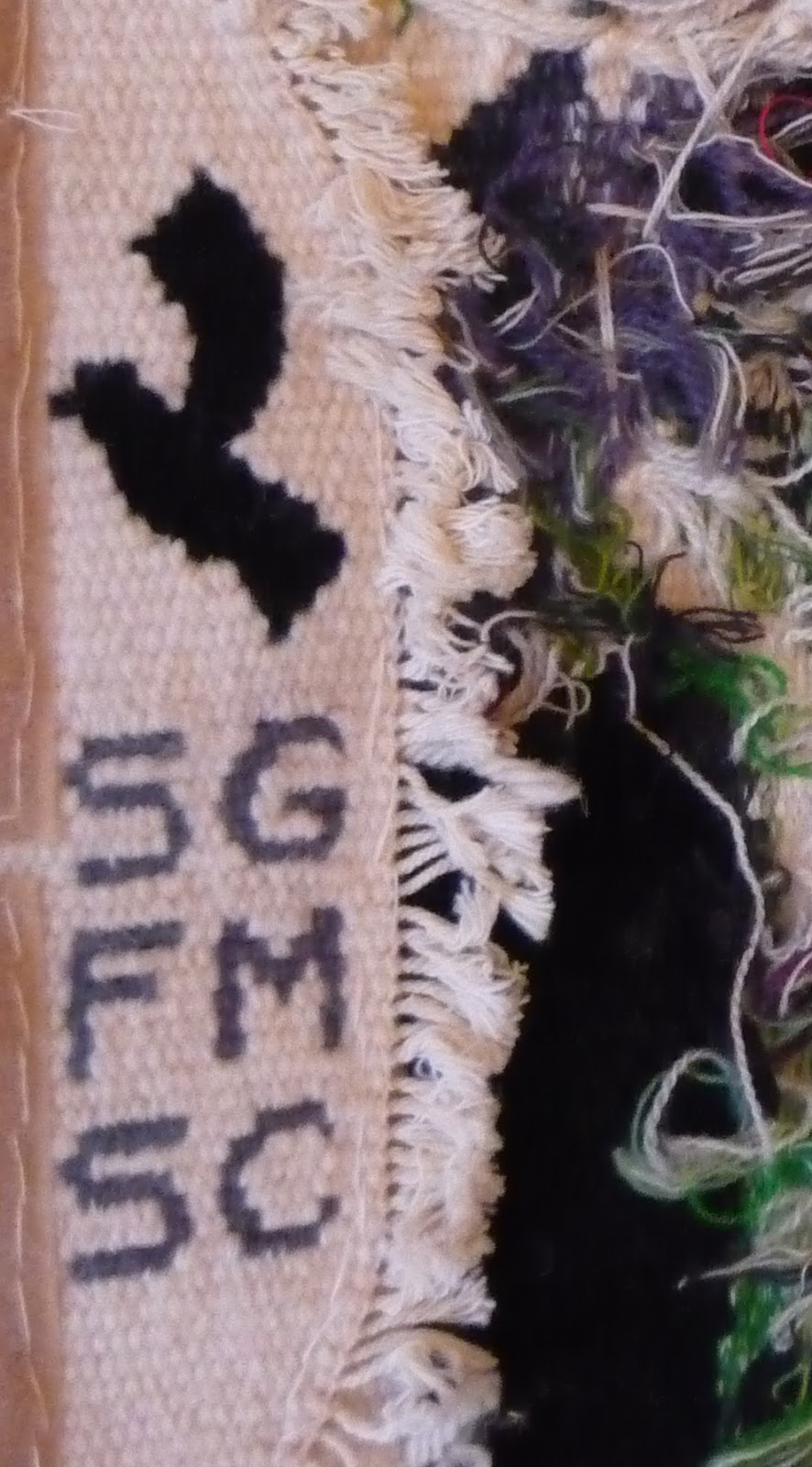
After the Second World War the practice remained the same, but at some point initials were moved to the back of tapestries. This was not a sudden change but happened gradually. The images below show the weavers' initials and Dovecot symbol (a subject for another blog post!) on the selvedge that is turned back on the tapestry.


As a researcher these initial serve a practical purpose. The archival information about Dovecot's history is patchy at best. Studio weavers are at risk of becoming anonymous if their names are not recorded in surviving archives or included on the physical tapestry. Some Dovecot tapestries do not include any initials!

In recent years the studio has been at pains to ensure that this does not happen in the future. There remain some projects that do not have an appropriate space for initials, such as quick, slow illustrated in the last post. However, in most cases it is possible, as in these small Peter Blake designed tapestries woven by Naomi Robertson - her initials are on the side of the mounts:


Thursday, 4 April 2013

Signed Tapestries (part 1): Artist-Designers

Whilst researching the 1950s at Dovecot, under the Directorship of Harry Jefferson Barnes and John Noble, I came across correspondence relating to the inclusion of an artist-designer's signature in a tapestry. The artist in question was Nadia Benois. On 5 November 1955 Benois wrote to Sax Shaw (Dovecot's Artistic Director) enclosing a copy of her signature. The studio was weaving a tapestry to one of her designs, Night and Day, and she expected her signature to be included on the front.


Just a few months earlier, on 7 August, Director John Noble had written the following to Shaw about Benois' tapestry:

I am entirely in favour of tapestries being marked to show designers and weavers. It is an old tradition and a good one, interesting for posterity. But I am not sure about the wisdom of signing them on the front. I feel that it suggests 'wool pictures' rather than tapestry and that the signature is apt to get in the way of the design to a much greater extent that it does in the painting.

These letters, found in the private archive of the Shaw family, illustrates that there was no 'correct' way of incorporating an artist's signature into a tapestry design - it was constantly up for debate. I thought it would be a good idea, therefore, to survey some examples from Dovecot's history and explore the debate from 1945 to the present day.

Detail from Marine Still Life, 1949, designed by Edward Wadsworth, woven by Richard Gordon, Dovecot Studios. Private Collection.
Detail of black and white photograph of Three Figures, 1950, weavers and location unknown.
After the Second World War, the Directors of Dovecot (then called the Edinburgh Tapestry Company), decided to invite famous contemporary artists to submit designs to the studio; the Directors then selected a number of them to be woven. The Directors (all members of the Bute family) were inspired by activities in France but also encouraged by the Council of Industrial Design. It was believed that collaborating with such artists would revitalise tapestry weaving, boost its profile and make the works easier to exhibit and sell. The name of the artist was an essential part of the marketing of the tapestries.

When Noble and Barnes became Directors in 1954 they decided to move away from using external artists as tapestry designers. Instead, they employed Sax Shaw as an in-house Artistic Director and tapestry designer. It was hoped that this change would save money (from artist fees) and make the tapestries more salable in a world that was increasingly aware of 'design' in the home. However, Shaw continued to include signatures on the tapestries he designed and, of course, in the Benois tapestry discussed above.

Detail of Still Life, 1950s, designed by Sax Shaw, weaver unknown. Private Collection.
Detail of Theseus and the Minotaur, 1956, designed by Sax Shaw, weavers unknown. Private Collection
The practice of including a tapestry designer's signature has continued to the present day. However it is not a consistent feature of tapestries at Dovecot. From the 1960s onwards signatures have only been included where necessary (e.g. if the artist or patron insists) or if it is able to fit comfortable within the design. Here are a couple of examples:

Aberdeen '64, 1964, designed by Archie Brennan, woven by Archie Brennan, Douglas Grierson, Maureen Hodge and Fred Mann. Aberdeen Art Gallery & Museums Collection.
Detail of Olive Terrace, 2009, designed by Barbara Rae, woven by Douglas Grierson, Naomi Robertson and Jonathan Cleaver. Private Collection.
There are some obvious examples of tapestries that have no appropriate space for a signature. This is especially the case when the tapestry is not meant as a simple wall hanging:

Tapestry woven for quick, slow, 2010 by Claire Barclay, woven by David Cochrane. Arts Council Collection.
Tapestry Circles and Green, 2011, David Poston, Bangle of welded stainless steel wire, tapestry woven cottons.Collaborative piece with Dovecot Studios, Edinburgh Jonathan Cleaver.
So far in this discussion of signatures the weavers have been absent. The second installment of this blog 'Signed Tapestries (part 2): Weavers' will examine Dovecot's inclusion of weavers' initials. Here's a taster of what's to come:

Tuesday, 5 March 2013

Tapestry and Reproduction: a useful research structure?

I am finally taking time to digest the papers of the 'Tapestry and Reproduction' CAA conference session. First I'll give a round up of the papers, then reflect on the value of 'tapestry and reproduction' as a means of inquiry for 20th and 21st Century tapestry practice.

Lorraine Karafel from Parsons the New School for Design spoke about 'reproduction and change in Raphael's designs for tapestries'. Lorraine explored the changes and alterations made to the borders of subsequent weavings of Raphael's Acts of the Apostles tapestry designs for the Sistine Chapel. These new borders were often designed by an artist contemporary to the new weaving and could be personalised with the iconography of the patron. Jonathan Kline, of Temple University, also discussed the Acts of the Apostles but focusing on three sets of tapestries all of which deviate significantly from Raphael's original cartoons. Jonathan questioned whether these sets would have been valued for their connection to celebrity artist Raphael, or for their own material, style and subject matter.

Susan Wagner of Columbia University moved the session forward in time with her paper on Boucher's 18th Century tapestry designs. Susan reinforced the fact that at least two of Boucher's oil paintings were made specifically for reproduction in tapestry. She asked: 'In what ways can we consider these works as being at once paintings and tapestries?'

Virginia Gardner Troy's paper examined the critical reception of the tapestries commissioned by Marie Cuttoli in the 1930s to 1960s. This subject provided the perfect paper with which to precede my talk as Dovecot would never have made tapestries designed by famous contemporary artists had it not been for Cuttoli's work in France.


As is often the case in conference sessions, the most exciting element was question time. I felt that the questions at the end of this panel were particularly astute and brought up many more issues than had been answered by the papers. Particularly, was the notion of 'tapestry as a means for reproducing painting' a valuable method of research and investigation? My response would be that it is limited. Though it is of great use for the Renaissance period up to the nineteenth century, There are many more centuries for which I do not consider it relevant. It is unlikely that Coptic tapestries were woven from paintings. It implies a hierarchy in which a painting holds the higher ground - but was this the case in the Medieval period? For example, were the painted cartoons of the Lady and the Unicorn held in higher esteem than the paintings? I suspect not. It is also problematic as we enter the twentieth century. Dovecot's collaborative activities with artists as designers has in many ways sustained a connection between painting and tapestry as many of these artists are indeed painters. However the relationship between each painting and tapestry is far more complex and nuanced than a simple reproduction. In the case of independent artist-weavers, I suspect for many the idea of reproducing a painting of tapestry does not play any part in their practice. There are of course some for whom painting and tapestry go hand in hand, but there are also others who do not paint at all. This is not a criticism of the CAA panel. The purpose of the session was to explore this very issue and the papers selected were all really well written and covered a rich and varied selection of topics.

My conclusion therefore is that there is no 'one-size-fits-all' method for studying tapestry. Each researcher has their own subjective views, and each weaver their own way of working. If I were to put forward what I think is most important, it would be to approach the topic with an open mind and begin, always, with the tapestry itself.

Friday, 25 January 2013

Conference News...

Being an academic can be hard sometimes - but not when it involves a trip to New York!


In a few weeks I will speaking at the College Art Association 101st Annual Conference (13-16 February). I will be giving a paper as part of a session entitled Tapestry and Reproduction. Here are the details:

"Tapestry and Reproduction"
Panel Co-chaired by K. L. H. Wells, University of Southern California; and Barbara Caen, The Frick Collection
College Art Association (CAA) 101st Annual Conference

Friday, February 15, 2013, 2:30-5pm
Sutton Parlor North, 2nd Floor
Hilton Hotel, Midtown New York

Featuring:
"Border Zones: Reproduction and Change in Raphael’s Designs for Tapestries"
Lorraine Karafel, Parsons The New School for Design

"Raphael/Not Raphael: The Curious Case of Loreto’s Acts of the Apostles Tapestries, and the Similar Sets in Zaragoza and Bryn Athyn"
Jonathan Kline, Temple University

“'Painting, with Silk and Gold'”: Boucher’s Intermediality"
Susan Wager, Columbia University

"Critical Reception of the Marie Cuttoli Tapestries, 1930s–1960s"
Virginia Gardner Troy, Berry College

"Reproduction/Interpretation/Transformation: Postwar Tapestry Making at Dovecot Studios, Edinburgh"
Francesca Baseby, University of Edinburgh
 
I feel so fortunate to be part of such an exciting looking panel and cannot wait to hear my fellow speakers. Online registration for the conference is now closed but details of how to buy tickets on the day can be found here.

Most readers of this blog are unlikely to be in New York just waiting for something to do on 15 February so I'll be sure to do a follow-up blog post about some of the ideas and issues that arise out of the session.

Tuesday, 8 January 2013

New Year - New Tapestry?

I intended to write something here about the past year in review but when you're working in academia the calendar year has less meaning than the academic one. I feel that, with 2013 just beginning, I ought to have completed some things and be on the brink of beginning others. Instead I find myself in the middle of the trickiest year of my PhD so far: THE FINAL YEAR OF DOOM. I am writing and editing and writing and editing and getting feedback and editing. It seems an endless cycle further complicated by the niggling voice in the back of my head reminding me that when the cycle finishes I will need to find a job.

So instead of moaning here are some uplifting tapestries for January:

2009 and 2010 Diaries, Tommye McClure Scanlin, image from here.
2012 Diary in Progress, Tommye McClure Scanlin, image from here.
 I have only just discovered the blog of Tommye McClure Scanlin. Tommye is based in the US and for the past few years have woven a tapestry diary for each calender year. Alongside her usual tapestry weaving projects, she weaves a small section of tapestry every day, reflecting her thoughts or mood. This has struck me as a fascinating idea. To commit to such a project means allowing yourself time, every day, to disconnect from your daily work or chores and tap into what you have been feeling. She is not the only weaver to create tapestry diaries but I enjoy seeing how they have changed in style, colour and form from year to year. The tapestries look so beautiful and tantalising - I only wish I could see one in person.

Monday, 3 December 2012

The Minotaur in Tapestry

The story of Theseus and the Minotaur can be found in Plutarch's The Rise and Fall of Athens. Theseus was the illegitimate son of Aegeus, ruler of Athens. Athens had been defeated by Minos of Crete and every nine years Athens was ordered to pay tribute in the form of seven young men and seven young women (anybody spotting the inspiration for The Hunger Games?). On their arrival on Crete, the youths were sent into a labyrinth which was inhabited by the Minotaur a vicious beast half-man half-bull. When Theseus first arrived in Athens (as a young man) tribute was due and he volunteered to go. Though Plutarch wrote that the details of the story differ from author to author, it is said that Theseus defeated and killed the Minotaur and led the other 13 tributes back to Athens safely.

Le Minotaure (1928) Pablo Picasso, black chalk and paper on canvas, National Museum of Modern Art, Pompidou Centre, Paris. Donated by Marie Cuttoli 1963.
The minotaur first features in a twentieth century tapestry in 1935. Marie Cuttoli owned a picture by Picasso of Le Minotaure and commissioned a tapestry of it from an Aubusson workshop. Picasso's image does not reflect a specific point in the story of the minotaur. The artist visited the subject of the minotaur repeatedly in his prints and drawings; this particular image is thought to be the first and is concerned with the grotesque combination of bull and man. It is an uneasy image, as if the legs of the man are struggling to escape from the head of the bull. It is an unlikely image for tapestry: it has a plain background and the central figure is executed as a line drawing.

Theseus and the Minotaur (1943-44) designed by Marc Saint-Saens, woven Aubusson, 284 x 478 cm, National Museum of Modern Art, Pompidou Centre, Paris
The subject of the Minotaur appears again almost a decade later in a tapestry designed by Marc Saint-Saens. Saint-Saens chose to focus on the moment that the minotaur was killed by Theseus. It is a bloody image as theseus plunges his sword into the bull's neck. His treatment of the subject and its translation into tapestry is in keeping with French tapestries of this period. Saint-Saens and his colleagues (includign Jean Lurcat and Dom Roberts) employed bold bright colours and plentiful detail to create weavings that took advantage of the unique nature of tapestry. This is in contrast to the Picasso piece which is essentially a drawing enlarged and copied into tapestry. Interestingly, the Minotaur is no longer half-man but is all-bull. It is reminiscent of bull fights and we may think this was the tapestry's subject were it not for Theseus' ancient dress. Given the political situation in France at this time, it is not surprising that Saint-Saens chose to focus on the moment of the Minotaur's defeat. Theseus takes on the role of France overcoming the fascist occupation of the Nazis.

Theseus and the Minotaur (1956) designed by Sax Shaw, weavers unknown, woven at Dovecot Studios.
detail of Theseus and the Minotaur
A Dovecot tapestry of Theseus and the Minotaur was woven in 1956 and designed by Sax Shaw, then artistic director. Shaw was very influenced and inspired by French tapestry designers and often adopted their imagery. However, he used these images and motifs in very different ways. His version of Theseus is more simplified and less violent that Saint-Saens'. Theseus' arm is raised, about to strike. Movement is suggested by the swirling patterns of solid colour, typical of Shaw's design style. This work makes the most explicit reference to the story as 14 tributes can be seen in the background (though it really ought to be 13).

Topics like this are one of my favourite parts of research: selecting a particular theme, image or effect and tracing its origins and development in the woven medium. I'm sure there will be many more to come.

Wednesday, 7 November 2012

Making Connections

There hasn't been much blog activity recently. Not because my research has ceased or the weavers have stopped weaving, but because I am in my third (and final) year - a time when editing and writing overtake active research.

I have been struggling with this stage - its doesn't involve looking at or feeling tapestries, delving into archives or visiting interesting places. It involves sitting at my desk staring at a screen or hundreds of files day after day. It is at times very solitary and frustrating, but I am also trying to remember how fortunate I am to have the space to think. I remind myself that when I am back at work I will not have such a luxury!


One real benefit of the editing process is that I am beginning to better understand the connections that can be made across my thesis, cutting through the chronological divisions of its chapters. For example, the issues of church decoration that influenced West's design for the Gould Memorial Tapestry are the same ones that Joyce Conwy Evans had to think about in the Canterbury Cathedral Altar Frontal. Both tapestries needed to feature religious iconography, fit in with the surrounding interior design and be visible to a large audience from a distance (both pictured above).

Numbered cartoon for Cycle of Life (1957-8) designed by Sax Shaw

The shadow (or light?) from French tapestry weaving was a constant presence throughout 1945 to 1970 in Dovecot's practice. Immediately after the war French tapestry became popular in Britain thanks to a major exhibition at the Victoria & Albert Museum in 1947. The successful resurgence of contemporary tapestry weaving under the guidance of John Lurcat was one of the influencing factors in Dovecot's decision to collaborative with living artists. Lurcat's influence continued into the 1950s when Sax Shaw was Artistic Director. Shaw adopted the French artist's methods - including the creation of full scale cartoons numbered with the corresponding colours to be used (images above). Tapestry by numbers indeed. By the 1960s, French tapestry was not so much an influence, but a parallel. The Lausanne Biennales, begun in 1962, enabled to Dovecot to promote its tapestries on an international level and develop its communication with international tapestry weavers.

On another note, I have two new reviews on RIO Magazine: Scotland Can Make It! (on at the People's Palace, Glasgow) and the annual Scottish Furniture Makers Association Exhibition. A review of Nuno Japanese Textiles currently on at Dovecot will be up shortly.

Monday, 10 September 2012

Tapestry, Gender, History

There came a moment in my research this week when I realised I was writing about the first tapestry both designed and woven entirely by women at Dovecot. This tapestry was Untitled (1967) designed by Elizabeth Blackadder and woven by Maureen Hodge. It is in the collection of the Scottish National Gallery of Modern Art. Gender does not form a large part of my thesis, but it is an unavoidable topic. It made me think about where tapestry sits in the arguments surrounding women and textiles.

Maureen Hodge weaving BP Tapestry in 1966.
Maureen was the first female tapestry weaver employed by Dovecot. She was recruited in 1964, immediately after completing the tapestry course at Edinburgh College of Art. She remained until 1973, when she was appointed head of the college's tapestry department. In 1950 Ronald Cruickshank, Head Weaver told the News Chronicle (9 February 1950) newspaper that he did not employ women as they would leave when they married and presumably he thought the years of apprenticeship would be wasted. This attitude did not change until the 1960s, with the emergence of female graduates from the tapestry course at Edinburgh College of Art.

Tapestry’s domination by men is at odds with the feminization of textiles, as expressed by feminist art historians such as Rozsika Parker. Embroidery is one particular example of a medium still dominated by women in the 1960s. Throughout the decade Embroidery magazine referred to the ‘embroideress’ or the ‘needlewoman’ instead of the gender neutral ‘embroiderer’. The editors of the magazine and almost all of its writers were women during the decade.

William Morris Company Merton Abbey Tapestry Workshop
In part, tapestry’s reputation as men’s work comes from its association with manufacture and factories. In the twenty-first century the western world views tapestry as a luxury, handmade artifact, but illustrations of earlier tapestry studios exhibit a less idealist view. The photograph of Morris’ Merton Abbey workshop shows a small, cramped studio designed to fit in as many looms and weavers as possible without losing natural light. In 1950, Dovecot was still considered to be a factory, as evidenced by correspondence regarding an inspection of the premises in that year. Any employee under the age of eighteen needed a certificate from a local doctor to prove their fitness for work.


However, the domination of tapestry by men can be traced back to pre-industrial Europe and into the Middle Ages. The Tapestry-Maker's Guild stipulated that only women could weave. One of the plot strands of Tracy Chevalier's novel The Lady and the Unicorn concerns the rules that stop weaver Georges de la Chapelle's wife, Christine, from helping him weave the tapestries.  Despite this, women could be involved in the preparation of tapestries. In Chevalier's book, Georges and Christine's daughter spends every evening sewing together the slits left between the warps in the tapestry. The involvement of needlewomen is evidenced in Medieval sources. In her publication The Troyes Memoire: The Making of a Medieval Tapestry Tina Kane discusses the account books of the Church of Sainte-Madeleine, also in Troyes. The account books include itemised payment to individuals involved in the commissioning of a series of tapestries for the Church - it is not known whether they were ever woven. These individuals include Poinsete, a seamstress, and her assistant. Poinsete was responsible for preparing full scale cloths for the cartoons to be painted on, and linings for the tapestry. (Kane's book is fascinating, both for her academic insight into her sources and for the translation of the Troyes Memoire itself)

This blog post really just scratches the surface of the matter of women and tapestry. The limits of my research mean I have not had time to spend on it - if you have any comments or further thoughts I would love to hear them!

Friday, 31 August 2012

Cockerels

This post has been a long time coming. In the late 1940s into the 1950s there seemed to be a plethora of tapestries of cockerels! (insert your own pun here) The first I noticed was Sax Shaw's Fighting Cocks (1950). It's a pretty gruesome tapestry, with large droplet of blood dripping from the cockerels' wounds and feathers flying. The brutality of the imagery is at odds with the delicate flowers filling the background.

Fighting Cocks, 1950, designed by Sax Shaw, woven by Ronnie McVinnie and Archie Brennan, Bute Collection.
Another can be found in the weird and wonderful Phases of the Moon, designed by Scottish artist John Maxwell and commissioned for the Scottish arts Council. It is currently in Dovecot's Weaving the Century exhibition if you would like to see the whole thing.

Phases of the Moon (detail), 1958, designed by John Maxwell, woven by Fred Mann and Harry Wright, Aberdeen Art Gallery and Museums.
Where were they all coming from? The answer was France. In their designs for tapestry, both Sax Shaw and John Maxwell were heavily influenced by French tapestries, particularly those designed by Jean Lurcat and Marc Saint-Saens. The cockerel, or rooster, is the national symbol of France. No surprise, then, that it became a feature of French tapestry design. But the relevance of the cockerel had a more personal meaning for Lurcat, who in turn had a great influence over his contemporaries.

Liberty (detail), 1943, designed by Jean Lurcat, woven at Picaud Atelier, Aubusson.
In his 1950 publication Designing Tapestry, Lurcat wrote poetically of an encounter he had with a cockerel in 1942:

On one of those resplendent mornings in the Lot region where I spent my 1942 exile, I saw in the meadow next to my studio, a cock, the most insolently cockish one to be found anywhere... The bird was overwhelmingly proud. The sun enveloped him, polished up his breast, made it shine, in fact made him a sort of Red God... This animal with its brilliantined crest and feathers, lunges like a fencer with each of his strides, and his claws come to ground like the wave of a marshal's baton. What glory! What splendour - an presents itself - a King! Versailles - the great monarch - the Roi Soleil! Hadn't I here the new poetic substance for a tapestry!... All that had to be done after that was to translate it into plastic form.
(Jean Lurcat 1950 Designing Tapestry (London, Rockliff) p.51-52)

One chance encounter was to have a significant effect on tapestry for the next two decades.

Wednesday, 25 July 2012

If I had to choose...

If I had to choose a favourite tapestry in the current Dovecot exhibition it would have to be Sky Cathedral II (1974) designed by Lousie Nevelson and woven by Gordon Brennan, Fiona Mathison, Neil McDonald and Jean Taylor.

photo
This tapestry took me completely by surprise. Before seeing the exhibition, I would have chosen Claire Barclay's quick, slow (2010) or Overall (1967) designed by Harold Cohen. I had only ever seen images of Sky Cathedral II and though keen on Nevelson's work the pictures of the tapestries she designed weren't really doing it for me. I think the nature of my encounter with it in the gallery had a big impact. Before reaching it in the exhibition, you come across an altarpiece designed by Joyce Conwy Evans. It is dazzling full of rich gold and bronze and bejewelled with embroidery. As you walk past it and round a corner you are suddenly met by the cooler, enveloping Nevelson.

photo
Photos rarely do a tapestry justice (the ones above certainly don't). They can't convey the deep vibrating blue yarn contrasted with the technically complex pale areas of weaving. This is a tapestry outstanding not only in its design and conception, but in its execution. The sense of texture, a reference to the three dimensional quality of the maquette on which the design was based, is achieved through a variety of techniques which are captivating in their delicate detail.

It is captivating.

 Details from Sky Cathedral (1982), Lousie Nevelson, Smithsonian Collection, Washington DC

Monday, 23 July 2012

Dovecot Centenary Exhibition is OPEN

Weaving the Century Exhibition, photo by Antonia Reeve
 The exhibition is open (details here) AND a September symposium has been announced!


Interweaving – Future Trends in Making, is Dovecot’s International Symposium for makers, doers and thinkers to come together to discuss and develop new practice and thinking.

Speakers will include:
Siobhan Davies – Choreographer and Dancer
Deirdre Nelson – Textiles Artist
Ruth Little – Dramaturg and Writer
Cat Rossi – Context Lecturer, Design School, Edinburgh College of Art/University of Edinburgh
Grainne Rice – Dovecot, Project Manager, Weaving the Century and Curator
Julie Brook – Visual Artist
More speakers to be announced shortly

Interweaving – Future Trends in Making is hosted at Dovecot as part of our 2012 centenary celebrations, and is brought together by Dovecot Studios and V&A at Dundee

Early bird price £70.00

Please call 0131 550 3660 to register your interest tickets will be available to buy online soon.

Wednesday, 4 July 2012

Dovecot's Namesake

This morning I visited Dovecot's namesake on Dovecot Road. The Doo'cot, as it is known by most Scots, is all that remains of Corstorphine Castle, thought to have been built around 1390. When Marquess of Bute built the original tapestry studio, which began operating in 1912, the Dovecot was included within the plot of land. This is why the studio was often referred to as The Dovecot even when its official name was Edinburgh Tapestry Studio.

It is also the inspiration behind the Dovecot symbol which is woven into every tapestry woven by the weavers. In some tapestries the symbol takes the form of a dove, but it most it is the Doo'cot itself. Though the studio has since been turned into a residence, you can still see the Doo'cot form the street. Hidden inside are 1060 nesting holes for pigeons.


The main purpose of my jaunt to Corstorphine was to visit the Corstorphine Trust. The trust is registered Scottish charity and does amazing research and outreach work to stimulate public interest in the Corstorphine, an area with a vibrant and fascinating history. Their website includes details of the opening hours of the Heritage Centre. The Trust has recently been gifted a Dovecot tapestry (which you can see here) and kindly invited Elizabeth Cumming and I to have a look. It is beautiful. It was woven around 1953 by Harry Wright as an apprentice piece and is very much influenced by the style of Sax Shaw. The Trust is currently deciding where to display it so that members of the public may view it.

Tuesday, 3 July 2012

It's almost time...

... for the Dovecot Centenary exhibition!


Regular readers will have noticed the 'button' on the right margin of the blog. Click on it, and it will take you directly to the Dovecot website. Here are some of the exciting things coming up:


Weaving the Century: Tapestry from Dovecot Studios 1912-2012
13 July - 7 October 2012
Curated by Dr Elizabeth Cumming
In the 100 years since Dovecot Studios was established, the weavers have collaborated with some of the most acclaimed British and international artists. Dovecot’s centenary exhibition presents the largest collection of Dovecot tapestries to be seen for 30 years. Admission if free.


 The Art of Modern Tapestry: Dovecot Studios since 1912
Edited by Dr Elizabeth Cumming
Published by Lund Humphries, 12 July 2012
Copies can be ordered now from Dovecot's website at a special exhibition price. 
This major new publication The Art of Modern Tapestry: Dovecot Studios since 1912 celebrates the work of Dovecot Studios, since its foundation in Edinburgh in 1912. The artistic value, nature and identity of modern tapestry are explored through images, essays and the commentaries of weavers, artists and patrons


A Tapestry of Many Threads
4 - 15 August 2012 (not 8 & 9)
Written by Alexander McCall Smith  Composed by Tom Cunningham
Directed by Mark Hathaway
Alexander McCall Smith and composer Tom Cunningham celebrate a century of vibrant and colourful Dovecot tapestries in the world premiere of this dramatised production featuring some of Scotland’s most exciting young singers and musicians. Performed on the Dovecot weaving floor, alongside the looms on which the tapestries are created, audiences will be taken on an atmospheric and often poignant journey inspired by the Studios’ world-famous tapestries via songs, music and the spoken word. Featuring Beth Mackay mezzo-soprano, Andrew McTaggart baritone,Stuart Hope piano and Jacqueline Norrie violin.
Tickets must be purchased direct from EdFringe.


Keep checking Dovecot's website for news of a Curator Tour and forthcoming Symposium.
Related Posts Plugin for WordPress, Blogger...