Tuesday, 8 January 2013

New Year - New Tapestry?

I intended to write something here about the past year in review but when you're working in academia the calendar year has less meaning than the academic one. I feel that, with 2013 just beginning, I ought to have completed some things and be on the brink of beginning others. Instead I find myself in the middle of the trickiest year of my PhD so far: THE FINAL YEAR OF DOOM. I am writing and editing and writing and editing and getting feedback and editing. It seems an endless cycle further complicated by the niggling voice in the back of my head reminding me that when the cycle finishes I will need to find a job.

So instead of moaning here are some uplifting tapestries for January:

2009 and 2010 Diaries, Tommye McClure Scanlin, image from here.
2012 Diary in Progress, Tommye McClure Scanlin, image from here.
 I have only just discovered the blog of Tommye McClure Scanlin. Tommye is based in the US and for the past few years have woven a tapestry diary for each calender year. Alongside her usual tapestry weaving projects, she weaves a small section of tapestry every day, reflecting her thoughts or mood. This has struck me as a fascinating idea. To commit to such a project means allowing yourself time, every day, to disconnect from your daily work or chores and tap into what you have been feeling. She is not the only weaver to create tapestry diaries but I enjoy seeing how they have changed in style, colour and form from year to year. The tapestries look so beautiful and tantalising - I only wish I could see one in person.

Monday, 3 December 2012

The Minotaur in Tapestry

The story of Theseus and the Minotaur can be found in Plutarch's The Rise and Fall of Athens. Theseus was the illegitimate son of Aegeus, ruler of Athens. Athens had been defeated by Minos of Crete and every nine years Athens was ordered to pay tribute in the form of seven young men and seven young women (anybody spotting the inspiration for The Hunger Games?). On their arrival on Crete, the youths were sent into a labyrinth which was inhabited by the Minotaur a vicious beast half-man half-bull. When Theseus first arrived in Athens (as a young man) tribute was due and he volunteered to go. Though Plutarch wrote that the details of the story differ from author to author, it is said that Theseus defeated and killed the Minotaur and led the other 13 tributes back to Athens safely.

Le Minotaure (1928) Pablo Picasso, black chalk and paper on canvas, National Museum of Modern Art, Pompidou Centre, Paris. Donated by Marie Cuttoli 1963.
The minotaur first features in a twentieth century tapestry in 1935. Marie Cuttoli owned a picture by Picasso of Le Minotaure and commissioned a tapestry of it from an Aubusson workshop. Picasso's image does not reflect a specific point in the story of the minotaur. The artist visited the subject of the minotaur repeatedly in his prints and drawings; this particular image is thought to be the first and is concerned with the grotesque combination of bull and man. It is an uneasy image, as if the legs of the man are struggling to escape from the head of the bull. It is an unlikely image for tapestry: it has a plain background and the central figure is executed as a line drawing.

Theseus and the Minotaur (1943-44) designed by Marc Saint-Saens, woven Aubusson, 284 x 478 cm, National Museum of Modern Art, Pompidou Centre, Paris
The subject of the Minotaur appears again almost a decade later in a tapestry designed by Marc Saint-Saens. Saint-Saens chose to focus on the moment that the minotaur was killed by Theseus. It is a bloody image as theseus plunges his sword into the bull's neck. His treatment of the subject and its translation into tapestry is in keeping with French tapestries of this period. Saint-Saens and his colleagues (includign Jean Lurcat and Dom Roberts) employed bold bright colours and plentiful detail to create weavings that took advantage of the unique nature of tapestry. This is in contrast to the Picasso piece which is essentially a drawing enlarged and copied into tapestry. Interestingly, the Minotaur is no longer half-man but is all-bull. It is reminiscent of bull fights and we may think this was the tapestry's subject were it not for Theseus' ancient dress. Given the political situation in France at this time, it is not surprising that Saint-Saens chose to focus on the moment of the Minotaur's defeat. Theseus takes on the role of France overcoming the fascist occupation of the Nazis.

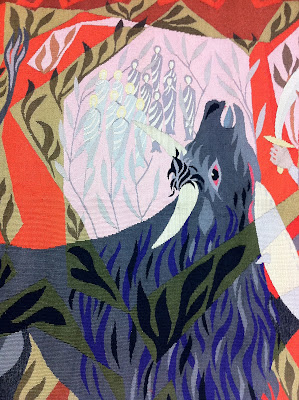
Theseus and the Minotaur (1956) designed by Sax Shaw, weavers unknown, woven at Dovecot Studios.
detail of Theseus and the Minotaur
A Dovecot tapestry of Theseus and the Minotaur was woven in 1956 and designed by Sax Shaw, then artistic director. Shaw was very influenced and inspired by French tapestry designers and often adopted their imagery. However, he used these images and motifs in very different ways. His version of Theseus is more simplified and less violent that Saint-Saens'. Theseus' arm is raised, about to strike. Movement is suggested by the swirling patterns of solid colour, typical of Shaw's design style. This work makes the most explicit reference to the story as 14 tributes can be seen in the background (though it really ought to be 13).

Topics like this are one of my favourite parts of research: selecting a particular theme, image or effect and tracing its origins and development in the woven medium. I'm sure there will be many more to come.

Wednesday, 7 November 2012

Making Connections

There hasn't been much blog activity recently. Not because my research has ceased or the weavers have stopped weaving, but because I am in my third (and final) year - a time when editing and writing overtake active research.

I have been struggling with this stage - its doesn't involve looking at or feeling tapestries, delving into archives or visiting interesting places. It involves sitting at my desk staring at a screen or hundreds of files day after day. It is at times very solitary and frustrating, but I am also trying to remember how fortunate I am to have the space to think. I remind myself that when I am back at work I will not have such a luxury!


One real benefit of the editing process is that I am beginning to better understand the connections that can be made across my thesis, cutting through the chronological divisions of its chapters. For example, the issues of church decoration that influenced West's design for the Gould Memorial Tapestry are the same ones that Joyce Conwy Evans had to think about in the Canterbury Cathedral Altar Frontal. Both tapestries needed to feature religious iconography, fit in with the surrounding interior design and be visible to a large audience from a distance (both pictured above).

Numbered cartoon for Cycle of Life (1957-8) designed by Sax Shaw

The shadow (or light?) from French tapestry weaving was a constant presence throughout 1945 to 1970 in Dovecot's practice. Immediately after the war French tapestry became popular in Britain thanks to a major exhibition at the Victoria & Albert Museum in 1947. The successful resurgence of contemporary tapestry weaving under the guidance of John Lurcat was one of the influencing factors in Dovecot's decision to collaborative with living artists. Lurcat's influence continued into the 1950s when Sax Shaw was Artistic Director. Shaw adopted the French artist's methods - including the creation of full scale cartoons numbered with the corresponding colours to be used (images above). Tapestry by numbers indeed. By the 1960s, French tapestry was not so much an influence, but a parallel. The Lausanne Biennales, begun in 1962, enabled to Dovecot to promote its tapestries on an international level and develop its communication with international tapestry weavers.

On another note, I have two new reviews on RIO Magazine: Scotland Can Make It! (on at the People's Palace, Glasgow) and the annual Scottish Furniture Makers Association Exhibition. A review of Nuno Japanese Textiles currently on at Dovecot will be up shortly.

Tuesday, 9 October 2012

RIO Magazine

This post is just to let you know that I am now contributing exhibition and publication reviews to RIO Magazine. Originally published in 2009 as a free bi-monthly magazine, it can now be found online. Founded by Tina Rose, the online magazine is for any with an interest in craft. Happy reading!


I have also updated the Papers/Talks page of the blog.
Related Posts Plugin for WordPress, Blogger...